Oklahoma City's Best Bat Removal
We've been voted Oklahoma City's best bat removal company the past two years!
Get in touch
Bat Experts
Rapid Response
Trained & Educated
Licensed & Certified
About Oklahoma City Bat Removal
Welcome to oklahomacitybat.com. We are the only qualified bat removal company in Oklahoma City, Oklahoma. We are a dedicated team of wildlife removal experts specializing in bat removal. Founded in 2009, we have provided bat removal services to residential, commercial, and industrial properties. Our integrated and holistic approach guarantees safe and effective solutions to your bat infestation issue. All our technicians are experienced and licensed in bat removal. Bat removal is specialty work because of the technical knowledge required to handle and remove them safely. That's why our technicians undergo numerous hours of training each year to keep their skills up to date and ensure satisfactory results in the field. We believe that a comprehensive inspection is essential in solving our client's bat problems. That's why we developed the comprehensive 32-point inspection technique that allows us to thoroughly examine your property to determine entryways nuisance bats are using to gain access into your attic, chimney, roof, garage, or any other part of your building. After inspection, we install exclusion devices to keep bats from reentering once they leave. Thereafter, we perform full decontamination of the infected space, as well as the necessary repairs on damaged parts of the property. At our company, we understand the importance of providing quick, safe, and effective removal and prevention services, so you can focus on what is important in your life. And as such, most appointments are made on the same day or the next. Our customer service reps are also available to listen to your concerns, and they are happy to answer any questions you might have. Kindly contact us today to get started! We operate 24-7-365, so don't hesitate to call us at 405-585-0144 to discuss your bat problem and schedule a fast appointment.
Residential
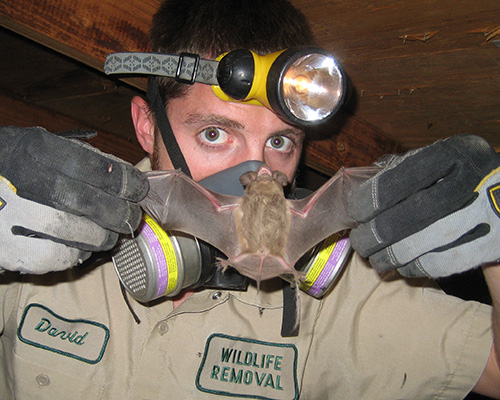
We are experts at removing bats from residential properties. Whether you have a single bat trapped in your house, a colony roosting in your attic, and/or various other problems, there is no need to worry! During our removal process, we make sure to inspect your entire home carefully, tracking down all the entrypoints bats are using to invade your place. Next, we perform a process called live exclusion (where no bats are harmed and all exit your property), then seal all entry holes completely shut. We also take care of the cleanup process after, so your home is safe and clean!
Learn MoreCommercial
Besides residential areas, we also have a wealth of experience removing bats from commercial properties! We begin by investigating the area for possible bat entrances, covering holes even as small as 1/4 of an inch. Through our live exclusion process, bats leave the building through one-way exits, and we seal up every hole afterward. Once the bats have been removed, we perform a cleanup process. This includes dealing with guano, replacing damaged insulation, and decontaminating the place.
Learn More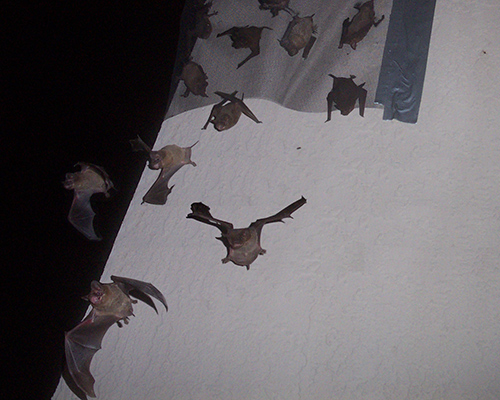
Contact us for bat removal today!
What Our Customers Say
I had a bat flying around in my house at 9pm, and CITY bat removal came right out and caught it in a net.
Sarah Lakewood
I had an annoying colony of bats stuck in my attic for a while before I finally decided to call for help. They were able to quickly and thoroughly solve the problem!
Brandon Chung
They did a great job clearing my attic of bats and didn't hurt any of the creatures.
Charlotte Demers
The technicians at CITY Bat Removal are skilled, professional, and know exactly what they're doing. Would highly recommend.
Mark O'Connor
My house stank of bats and their guano inside my wall. CITY Bat Removal not only removed the bats, they also got rid of the smell!
Alexis Ramirez
.jpg)
Biology of Big Brown Bat: Appearance, Biology, Life Cycle, Habitat, Diet, Behavior
Appearance
The aptly named big brown bat has a glossy reddish-brown coat of fur. Despite having "big" in its name, the bat only weighs around 20 grams, and it has a wingspan of around 13 inches (roughly 35 centimeters).
These bats have a flat nose which — along with their wings — are hairless. As hunters, their mouths are lined with 32 sharp teeth.
Biology and Life Cycle
Like many other bat species, the big brown bat's mating season is during the fall. During this time, male and female bats will couple, but the female will not enter their pregnancy.
Instead, female bats then hibernate until spring. Only then do they enter their gestation period, where they will give birth to a young pup. Most big brown bats only have one child a year, though some do give birth to twins.
These pups are small, weighing only 5 grams at birth. They're also bald and blind, so they rely solely on their mother's protection for the first few days of their lives. Yet they quickly grow in size and strength, and they become fully grown within a month of being born.
During this time, the pups often stay in their roost as the mother goes out and hunts for them both. Yet after a few weeks, the pup becomes strong enough to start flying on its own.
Despite their quick progression into adulthood, these bats live for a very long time for animals of their size. In fact, the average life expectancy of a big brown bat is between 6 to 7 years out in the wild. Though they can easily live for twice that amount in captivity.
Habitat
The big brown bat is primarily found in North America, where it mostly resides in Southern Canada and the US. Yet these bats can also be found more to the south, where people have spotted them in the Caribbean and Colombia.
Big brown bats have adapted to many environments, which is why they're found in cities, forests, deserts, plains, and plenty of other areas as well.
Diet
Like most other bat species, the big brown bat is an insectivore. This means it primarily hunts and eats various insects. These include flies, cockroaches, beetles, and more.
These flying mammals have to eat a lot of insects a night to sustain their active lives, making them a great way to cut down on insect populations. This is just one of the ways that bats help people, as they hunt a lot of agricultural pests.
Behavior
The big brown bat is mostly active at night. This means that it is nocturnal like most other bat species. These nocturnal animals rest for most of the day, where they avoid large predators. Instead, they opt to hunt at night, where they can fly without fear of eagles and other large birds attacking them.
For hunting, these animals use echolocation. This technique involves emitting sounds around them and listening to the echoes or sounds bouncing back. These clever bats are able to navigate their environment and hunt prey by deciphering these sounds.
Not all bats hibernate, but big brown bats do. They either hibernate alone or in small colonies — often in caves or manmade structures.
During the spring and summer, these bats form maternity colonies. Here, the female bats work together to raise all their young. It provides the pups with a safe place to live, and it allows the mothers to share their efforts and provide food for all.